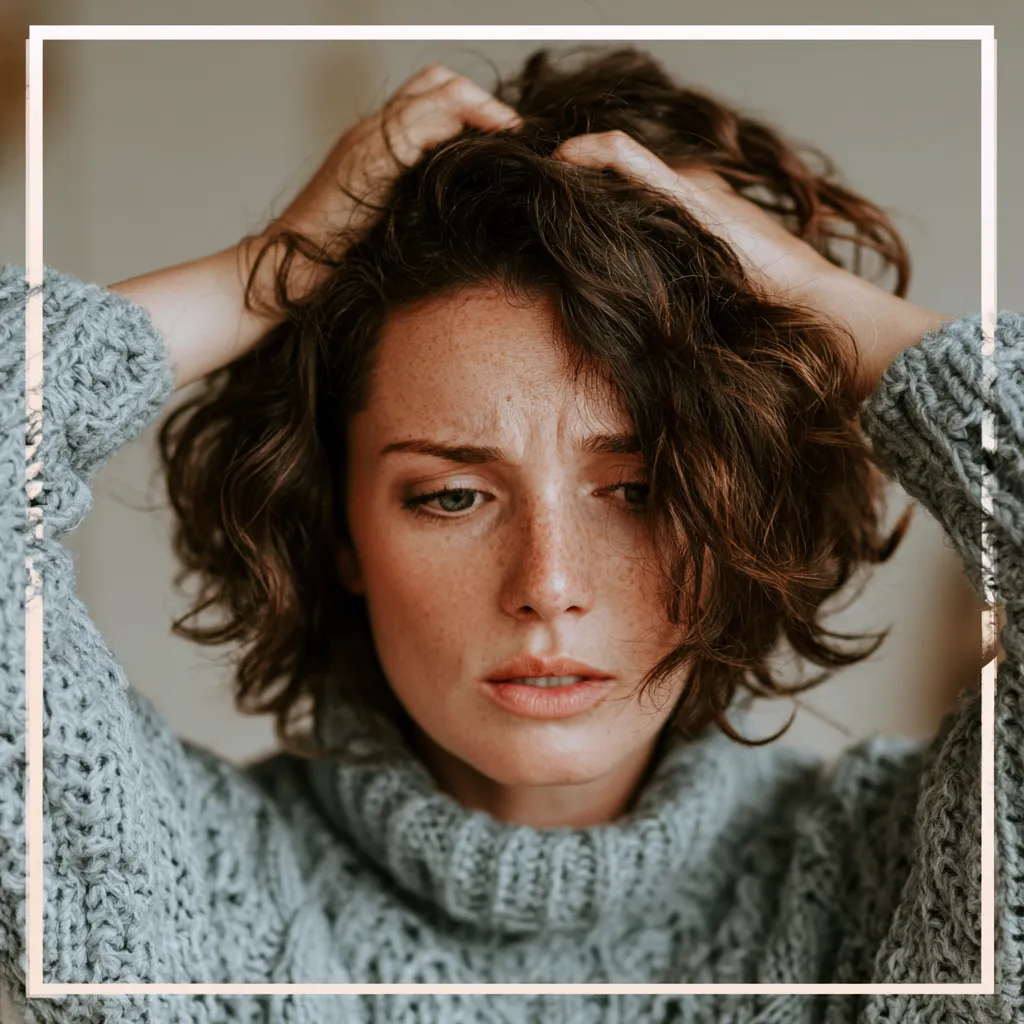
Perimenopause in Your 30s: Signs Most Women Miss
Perimenopause in Your 30s: Yes, It's Really a Thing
Let's call her Sophie.
She's 36.
She's always had a predictable cycle. The kind where she could almost set her watch by it.
She's organised. Capable. The one everyone leans on.
But lately?
Something feels... different.
Her periods have quietly shifted from every 28 days to every 24.
She's waking at 3:17am most nights.
Not because the kids are awake.
Not because she's stressing about work.
She's just... awake.
Her patience is wearing thin.
Her energy has packed its bags.
She's crying over adverts she'd normally laugh at and wondering why everything suddenly feels so much harder.
So she books a GP appointment.
"It's probably stress."
"You're far too young for perimenopause."
She leaves feeling relieved...
...for about five minutes.
Then the doubt creeps in.
Maybe she's overthinking it.
Maybe she's just burnt out.
Maybe this is simply what life in your 30s feels like.
Here's the thing...
It wasn't "just stress."
And Sophie isn't unusual.
In fact, she's one of countless women I meet who've spent months—sometimes years—questioning themselves before discovering their hormones had quietly been changing the rules all along.
Let's be real...
If you're in your 30s, the word perimenopause probably isn't even on your radar.
You're thinking:
"I'm too young."
"Surely this doesn't happen until your forties?"
"Maybe I just need a proper night's sleep."
So when your once-predictable cycle suddenly starts doing its own thing, your sleep changes for no obvious reason, or your moods feel unfamiliar, it's easy to explain it away.
Or worse...
Someone else explains it away for you.
But here's the truth.
Perimenopause can begin in your late 30s—and for some women, even earlier.
You're not imagining it.
And you're certainly not "too young."
Perimenopause doesn't wait until you're 45
One of the biggest myths I hear?
That perimenopause starts at 45.
Truthbomb 💥
Hormones don't own calendars.
Perimenopause isn't a switch that suddenly flips on one birthday. It's a hormonal transition that can begin years before your periods become obviously irregular—and for some women, that journey starts much earlier than expected.
In clinic, I regularly see women in their early-to-mid 30s experiencing classic hormonal shifts that fit early perimenopause.
Yet because of their age, they're often told it's probably stress.
Or they're busy.
Or they're juggling too much.
Could those things contribute?
Absolutely.
But age alone shouldn't rule out what your hormones may already be telling you.
Your birthday isn't a diagnostic tool.
The early signs most women don't realise could be hormonal
One of the reasons early perimenopause gets missed?
The symptoms don't usually arrive all at once.
They quietly weave themselves into everyday life.
You wake at 3am for no obvious reason.
Your period starts arriving a little earlier every month.
PMS suddenly feels more intense than it ever used to.
You're exhausted, but sleep doesn't seem to fix it.
Your skin feels drier.
Your hair seems thinner.
You don't quite feel like yourself anymore...
...but you can't put your finger on why.
Some of the most common early signs include:
Changes in cycle length or timing
Sleep disruption
New or worsening PMS
Mood changes that feel out of character
Fatigue that lingers despite rest
Skin or hair changes
Now, any one of these symptoms could have several different causes.
But when multiple changes begin showing up together—particularly alongside genuine changes in your cycle—it's worth asking a different question.
Could your hormones be shifting?
Why does it happen earlier for some women?
Here's where things become interesting.
Hormones don't decline in a perfectly straight line.
Oestrogen and progesterone can begin fluctuating years before periods become noticeably irregular.
For some women, family history plays a role. If your mum or older sister experienced an earlier perimenopause, there's a chance you may too.
For others, previous hormonal conditions, chronic stress, or simply individual biology can influence when these hormonal shifts begin.
Which is exactly why hearing "you're too young" isn't actually an answer.
It's an assumption based on averages.
Your hormones don't always follow the average.
So... what actually helps?
Here's the good news.
You don't have to spend the next decade wondering whether it's "just stress."
And you certainly don't have to wait until someone decides you're finally old enough to deserve answers.
The goal isn't simply to label everything as perimenopause.
It's understanding your hormonal pattern.
As a registered medical herbalist, that's where I begin.
Rather than looking at one symptom in isolation, I take in the bigger picture—your menstrual cycle, sleep, mood, energy, medical history and overall health—to understand what's really driving your symptoms.
From there, herbal medicine can be tailored to support your body's changing hormonal landscape, helping ease symptoms such as poor sleep, mood fluctuations and fatigue while supporting your body's natural transition.
One of the simplest things you can do?
Start tracking.
Notice your cycle.
Notice your sleep.
Notice your mood.
Patterns often reveal what isolated symptoms can't.
And perhaps most importantly...
If you've been dismissed because of your age alone, please know this:
You deserve to be heard.
You deserve someone who treats the woman sitting in front of them—not simply the number on their birth certificate.
Where to start
If you've found yourself reading this and quietly nodding along...
Don't ignore what your body has been trying to tell you.
The sooner you understand what's really happening, the sooner you can stop second-guessing yourself and start getting the support you deserve.
Take my "Where Do I Start?" quiz to discover which hormone pattern may be behind your symptoms—and your next best step.
Marie Mulcahy is a NIMH-registered Medical Herbalist (MNIMH) specialising in hormone health, supporting women across Lancashire and throughout the UK via online consultations.
References
Cunningham et al. (2025) — Perimenopause symptoms, severity, and healthcare seeking in women in the US. npj Women's Health. Reviewed data from over 4,400 women and found 55.4% of those aged 30–35 reported moderate-to-severe symptoms on the Menopause Rating Scale. https://www.nature.com/articles/s44294-025-00061-3
UVA Health / Flo Health (2025) — study co-led by Dr. Jennifer Payne (UVA Health, University of Virginia School of Medicine) on perimenopause symptoms in women aged 30–35. https://news.virginia.edu/content/uva-study-reveals-women-suffer-menopause-symptoms-decades-early
Journal of Bio-X Research — Genetic aspects of early menopause. Twin and family studies show age at natural menopause onset is highly heritable (44–65%), with daughters of mothers who had early menopause at significantly higher risk. https://spj.science.org/doi/10.1097/JBR.0000000000000043
Insights into Perimenopause: A Survey of Perceptions, Opinions on Treatment, and Potential Approaches — PMC. Notes reports of perimenopausal symptoms beginning as early as age 35, against a commonly cited average onset of 45–47. https://pmc.ncbi.nlm.nih.gov/articles/PMC12014197/

