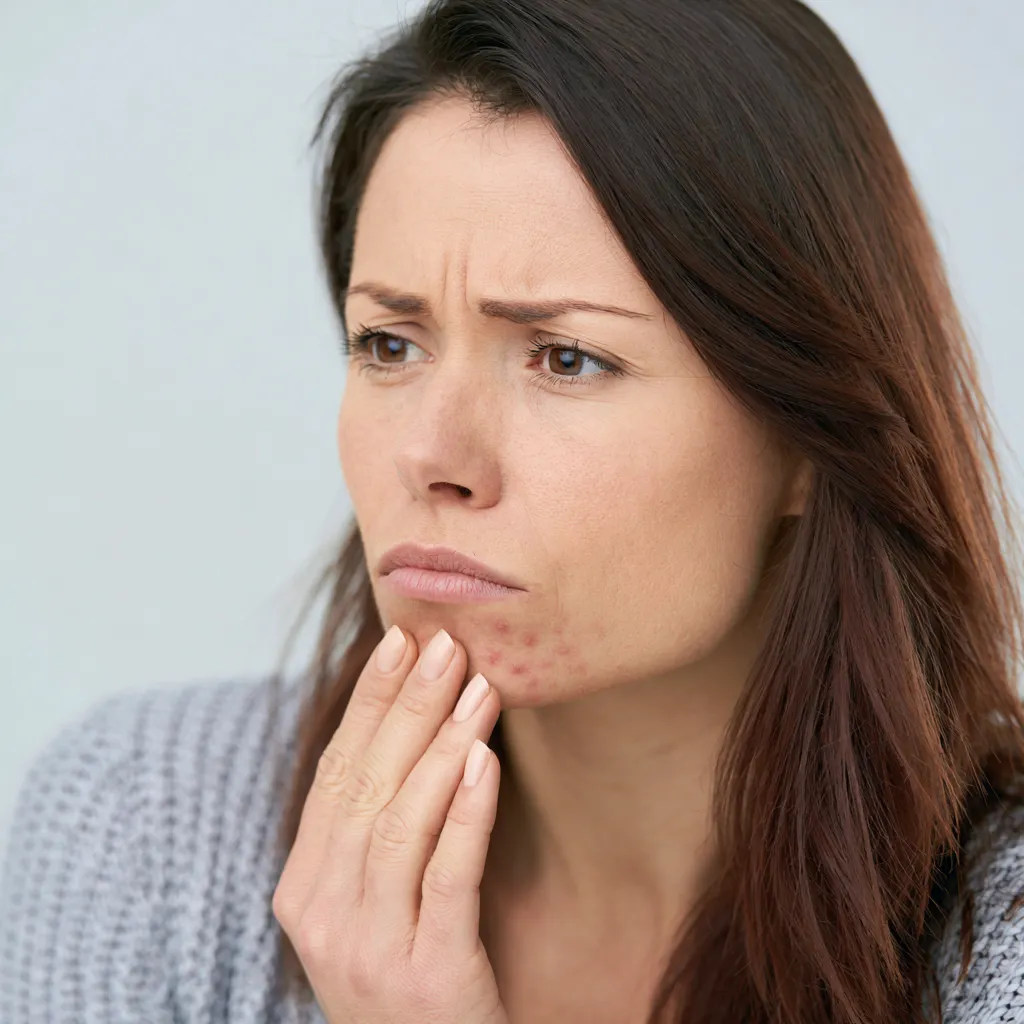
Hormonal Acne on Your Jawline in Your 30s? Here's What Your Skin Could Be Trying to Tell You
If you've found yourself Googling "hormonal acne jawline 30s," firstly... welcome. And secondly? You're definitely not alone.
One day your teenage acne feels like a distant memory.
The next?
You're dealing with painful, stubborn breakouts that seem to set up camp around your chin and jawline.
You've bought the cleanser.
Tried the spot treatment.
Changed your moisturiser.
Maybe you've even overhauled your entire skincare routine.
And yet... those same deep, sore pimples keep coming back.
Sound familiar?
Here's the thing.
Your skin isn't random.
Sometimes, where your acne appears can give us important clues about why it's happening.
According to the American Academy of Dermatology and DermNet NZ, acne that repeatedly appears around the chin and jawline is commonly associated with hormonal fluctuations, particularly in adult women. It often behaves differently from teenage acne and may require a different treatment approach.
Let's break down why this happens—and what your skin could be trying to tell you.
Quick Takeaways
✔ Recurring acne around the jawline and chin is commonly associated with hormonal fluctuations.
✔ Hormones called androgens can increase oil production, contributing to painful breakouts.
✔ Conditions like Polycystic Ovary Syndrome (PCOS) may be one possible cause—but jawline acne alone doesn't necessarily mean you have PCOS.
✔ While a consistent skincare routine is important, addressing the underlying cause is often just as important for long-term improvement.
✔ If your acne is persistent, painful or affecting your confidence, it's worth speaking with your GP or healthcare provider.
Why Does Hormonal Acne Show Up on the Jawline?
Think of your skin as a messenger.
Different areas of the face can sometimes provide clues about what's happening inside the body.
When acne repeatedly appears around the jawline, chin and neck, hormones are often part of the conversation.
Unlike the whiteheads and blackheads many of us experienced as teenagers, hormonal acne tends to look—and feel—a little different.
You might notice:
Deep, painful bumps beneath the skin
Cystic breakouts that don't come to a head
Acne that returns in the same spots every month
Pimples that seem to take weeks to heal
Dermatology resources, including DermNet NZ, note that adult hormonal acne commonly affects the lower face and is often driven by inflammation and increased oil production rather than surface congestion alone.
Why Your 30s Can Bring on Hormonal Acne
Many women are surprised when acne appears—or comes back—in their 30s.
After all...
"Shouldn't acne be over by now?"
Not necessarily.
Hormones naturally fluctuate throughout adulthood.
Pregnancy, postpartum recovery, stopping hormonal contraception, chronic stress and the transition towards perimenopause can all influence how your skin behaves.
Research and clinical guidance from the American Academy of Dermatology suggests that adult female acne is incredibly common, with hormonal fluctuations playing a significant role in many women experiencing breakouts well beyond their teenage years.
The Link Between Androgens and Jawline Acne
One of the biggest drivers of hormonal acne is a group of hormones called androgens.
Although they're often referred to as "male hormones," women naturally produce and need androgens too.
The problem isn't necessarily having androgens—it's when levels become elevated or when the skin becomes more sensitive to them.
Higher androgen activity can stimulate the sebaceous (oil) glands to produce more oil.
That excess oil mixes with dead skin cells and bacteria, creating an environment where painful inflammatory acne can develop.
According to DermNet NZ, increased sebum production driven by androgen activity is one of the key reasons hormonal acne commonly develops around the jawline and chin.
Could Jawline Acne Be a Sign of PCOS?
For some women, yes.
Persistent jawline acne can be one of several signs of Polycystic Ovary Syndrome (PCOS).
PCOS is one of the most common hormonal conditions affecting women of reproductive age.
Clinical guidance from Jean Hailes for Women's Health and the International Evidence-Based Guideline for PCOS recognises acne as a common skin manifestation of PCOS because higher androgen levels can stimulate excess oil production.
However, jawline acne on its own doesn't automatically mean you have PCOS.
If you're also experiencing:
Irregular or absent periods
Increased facial or body hair
Hair thinning
Weight changes
Difficulty conceiving
it's worth discussing your symptoms with your GP or healthcare provider.
Receiving an accurate diagnosis can help guide the most appropriate treatment for both your skin and your overall health.
Why Skincare Alone Isn't Always Enough
Let's be real.
If hormones are driving your acne, another expensive cleanser probably isn't going to solve the problem on its own.
That's why so many women feel frustrated.
They're doing "everything right."
They're investing in quality skincare.
Yet the same painful breakout keeps returning month after month.
A good skincare routine absolutely matters.
It helps support your skin barrier, reduce inflammation and keep pores healthy.
But clinical guidance, including the NICE Acne Vulgaris Management Guideline, highlights that persistent hormonal acne often benefits from treatment that addresses the underlying hormonal drivers alongside an appropriate skincare routine.
That's why understanding the why behind your acne is just as important as choosing the right cleanser.
Frequently Asked Questions
Can PCOS cause jawline acne?
Yes.
PCOS is one of the most common hormonal conditions associated with persistent jawline acne because it can increase androgen levels.
Clinical guidance from Jean Hailes for Women's Health and the International Evidence-Based Guideline for PCOS recognises acne as a common symptom of PCOS, particularly when it's accompanied by irregular periods, excess facial hair or hair thinning.
However, jawline acne alone isn't enough to diagnose PCOS. If you're experiencing multiple symptoms, it's important to speak with your GP or healthcare provider.
Will skincare clear hormonal acne?
A consistent skincare routine can reduce inflammation, strengthen your skin barrier and improve the appearance of breakouts.
However, the NICE Acne Vulgaris Management Guideline recommends that persistent hormonal acne often requires treatment that addresses the underlying hormonal drivers alongside an appropriate skincare routine.
If your acne continues to return despite looking after your skin, it's worth seeking personalised medical advice.
Further Reading
For readers wanting to learn more, these evidence-based resources provide reliable information on hormonal acne and PCOS:
American Academy of Dermatology – Hormonal acne
DermNet NZ – Acne
Jean Hailes for Women's Health – Polycystic Ovary Syndrome (PCOS)
National Institute for Health and Care Excellence (NICE) – Acne vulgaris: Management
International Evidence-Based Guideline for the Assessment and Management of Polycystic Ovary Syndrome (2023)
Medical Disclaimer
This article is intended for educational purposes only and shouldn't replace personalised medical advice. If you're experiencing persistent, painful or recurring acne—or you're concerned howabout symptoms of hormonal imbalance—please speak with your GP, dermatologist or qualified healthcare provider to determine the most appropriate treatment for your individual circumstances.

