PCOS in Your 40s: Is It Perimenopause, PCOS, or Both?
If you've had PCOS for most of your adult life, you probably assumed it was something you'd eventually "grow out of." Then your 40s arrived, your symptoms didn't disappear — they changed, multiplied, or got worse — and now you're left wondering whether what you're feeling is still PCOS, whether it's perimenopause starting, or whether it's both happening at once.
You're not imagining it, and you're not alone in the confusion. This is one of the most under-discussed overlaps in women's hormonal health, and most content out there is written for women in their 20s and 30s trying to conceive — not for women in their 40s trying to figure out what's actually going on with their bodies now.
Why PCOS Doesn't Just "Go Away"
PCOS is often talked about as a fertility issue, which leaves a lot of women believing it becomes irrelevant once their childbearing years are behind them. In reality, PCOS is a lifelong hormonal pattern, not a phase. The androgen and insulin dynamics that shaped your 20s and 30s don't switch off — they interact with a whole new set of hormonal shifts as your body moves toward perimenopause.
Some women with PCOS even reach natural menopause slightly later than average, and the ongoing hormonal activity that causes this can also mean perimenopause feels more chaotic, not less, when it arrives.
Where the Two Patterns Overlap
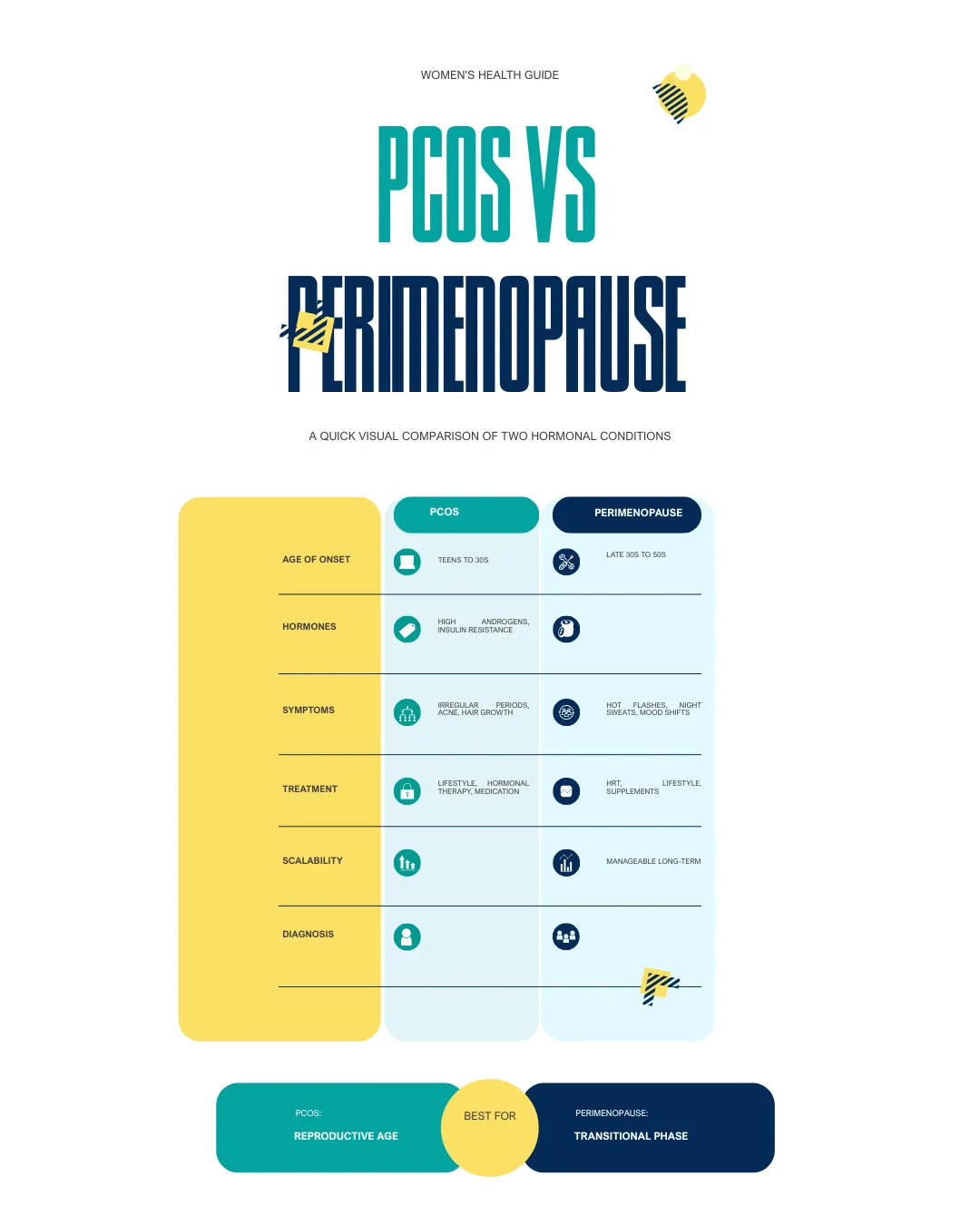
This is the part that trips most women up — and often their GPs too. Several core symptoms show up in both conditions, but for different underlying reasons:
Irregular or unpredictable cycles — In PCOS, cycles go off-track because ovulation isn't happening consistently. In perimenopause, cycles lengthen and become erratic as ovarian reserve naturally declines. Same symptom, two different engines driving it — and you often can't tell which is which just by watching your calendar.
Weight and metabolic changes — PCOS is closely tied to insulin resistance, which drives weight gain (especially around the middle) and makes weight loss frustratingly difficult. Perimenopause brings its own metabolic shift as declining estrogen changes how your body stores fat and processes sugar. When both are active, the effect compounds rather than cancels out.
Mood swings and anxiety — Both conditions disrupt the neurotransmitter systems that keep mood steady, just via different mechanisms — androgen and progesterone irregularities in PCOS, erratic estrogen swings in perimenopause. This is often where women feel most dismissed, told it's "just stress" or "just hormones" without anyone digging into which pattern is actually driving it.
Brain fog — Estrogen plays a direct role in memory and mental clarity, so perimenopause's estrogen volatility affects cognition on its own. PCOS-related insulin resistance can independently contribute to brain fog too, which is why this symptom often feels disproportionately severe for women navigating both at once.
What Points More Clearly to Perimenopause
A few signs tend to be perimenopause-specific rather than PCOS-related:
Hot flushes and night sweats
Vaginal dryness or changes in comfort
A pattern of cycles becoming steadily more infrequent over recent years, rather than just irregular
If you're noticing these alongside your usual PCOS symptoms, it's a reasonable sign perimenopause has entered the picture.
Why You Can't Always Tell From a Single Blood Test
One of the most frustrating parts of this overlap is that standard hormone testing often doesn't resolve it. A single FSH reading, for example, is notoriously unreliable for staging perimenopause — and hormone levels that look "normal" on paper don't rule out either condition. Getting a fuller picture usually means looking at patterns over time, not one snapshot.
This is exactly the kind of complexity that gets missed in a rushed ten-minute GP appointment, and exactly where working with someone who looks at your whole pattern — cycle history, symptoms, timing, and how they interact — makes the difference between generic advice and something that actually fits what's happening in your body.
Which Pattern Are You In?
If you've read this far nodding along, the real question isn't "is it PCOS or perimenopause" — it's which combination of patterns is showing up for you, because that's what determines what actually helps.
Take the free Hormone Pattern quiz to get a clearer sense of what's driving your symptoms: Take the Quiz
Or if you're ready to get to the bottom of it with proper support, book a consultation: Book Now
FAQ
Can you have PCOS and be in perimenopause at the same time? Yes. PCOS is a lifelong hormonal pattern that doesn't resolve on its own, and perimenopause can begin while PCOS is still active — meaning both sets of hormonal shifts can overlap and compound each other.
Does PCOS get better or worse during perimenopause? It varies, but many women find their symptoms feel more severe and harder to pin down during perimenopause, since two hormonal disruptions are layering on top of each other rather than one replacing the other.
How do I know if my irregular periods are PCOS or perimenopause? Cycle pattern alone often isn't enough to tell — both conditions cause irregular cycles through different mechanisms. Looking at the fuller picture (additional symptoms, timing, hormone patterns over multiple cycles) gives a clearer answer than a single test or symptom in isolation.
Does PCOS go away after menopause? No — some PCOS-related symptoms, particularly those linked to androgens (like hair changes or acne), can persist after menopause, even though periods have stopped.
References
Joshi A, Bahri Khomami M. Editorial: A lifecourse perspective on polycystic ovary syndrome (PCOS): bridging gaps in research and practice. Frontiers in Endocrinology. 2026. DOI: 10.3389/fendo.2026.1794443
Florida Atlantic University. Scoping review of 29 peer-reviewed studies on non-pharmacological management of PMOS (PCOS) during perimenopause and menopause. Published in American Journal of Lifestyle Medicine, 2026.
Systematic review: Impact of lifestyle interventions on reproductive and psychological outcomes in women with polycystic ovary syndrome. PMC. 2025. Available at: https://www.ncbi.nlm.nih.gov/pmc/articles/PMC11749783/
Pangalangan JML, Tollefson M. Perimenopause and Lifestyle Medicine: A Window of Opportunity. American Journal of Lifestyle Medicine. 2026. DOI: 10.1177/15598276261449751
Custom HTML/CSS/JavaScript

